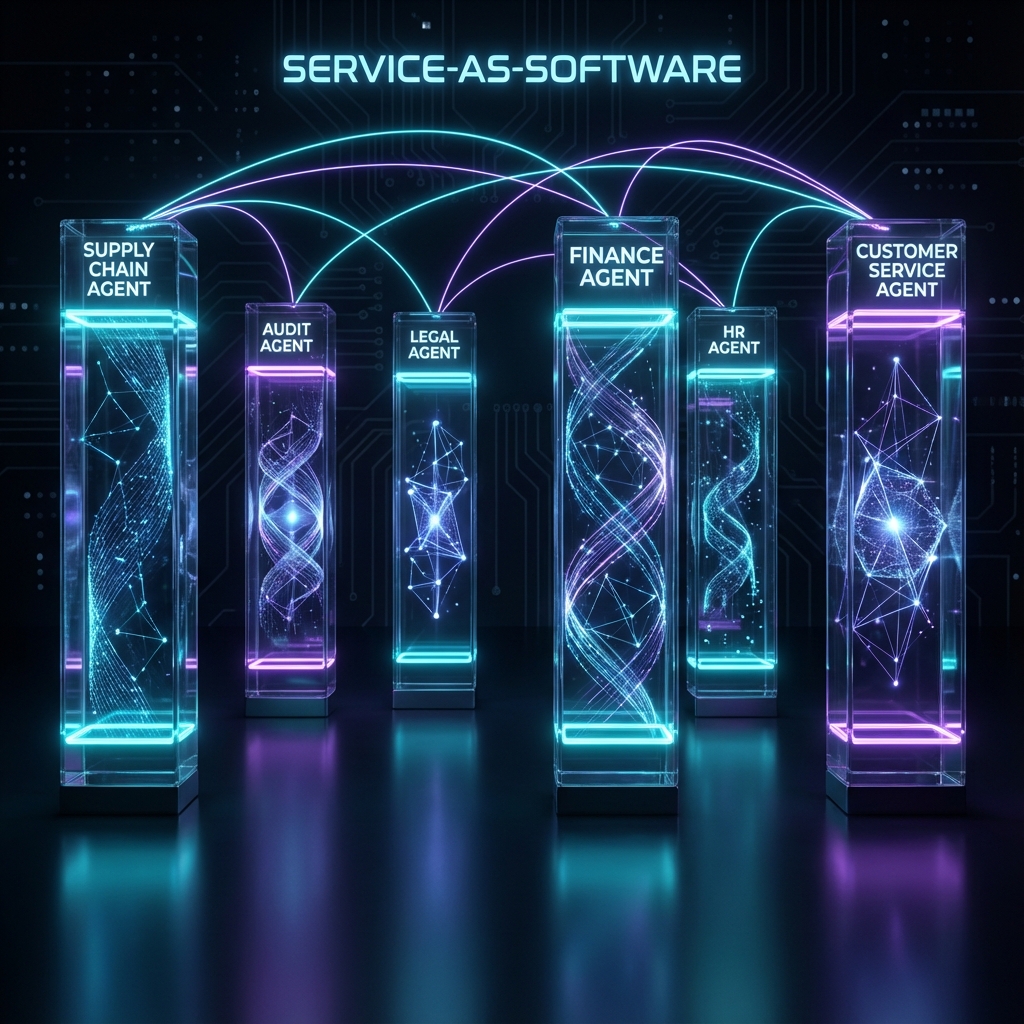
The golden era of SaaS (2010-2023) was built on a simple, predictable metric: The Seat.
Investors loved it. Revenue was a function of Headcount × $Price/Month. If your
customer grew, their bill grew. It was a perfect alignment with the "Zero Interest Rate
Phenomenon" (ZIRP) era of massive hiring.
But in the age of Agentic AI, "The Seat" is a toxic asset. It penalizes efficiency and caps value. We are witnessing the death of Software-as-a-Service and the birth of Service-as-Software (S.a.S.)—a shift from selling tools to selling outcomes.
This isn't just a pricing change; it's an existential crisis for the $300B B2B software industry. Here is the rigorous economic analysis of why.
1. The Economic Perversion of SaaS
Traditional SaaS incentives are fundamentally perverse when applied to AI. Let's look at the "Inefficiency Incentive."
A traditional CRM vendor (like Salesforce) wants you to hire more salespeople. Your inefficiency (needing 50 humans to make 1,000 calls) is their growth driver. If you found a way to make 1,000 calls with 1 human, the vendor's revenue would collapse by 98%.
The SaaS Trap
- Metric: Seats (Licenses)
- Incentive: Maximize Customer Headcount
- Result: Vendor profits from Customer Inefficiency.
Enter the AI Agent. An Agent is an entity that can perform the work of a human without the "Seat." If a SaaS vendor sells you an "AI Copilot" for $30/month, but that Copilot allows you to fire 5 humans, the vendor has cannibalized their own revenue stream.
Furthermore, AI Models have Marginal Costs of Goods Sold (COGS). A human user clicking buttons costs the vendor nearly $0. An Agent running GPT-4o loops for 24 hours costs real money in inference. Pricing this at a fixed $30/month is a "Suicide Pricing" strategy—power users will bankrupt the vendor.
2. Service-as-Software (S.a.S.)
The solution is to decouple price from participation. We stop charging for the software and start charging for the service it performs.
This is Outcome-Based Pricing.
The S.a.S. Revolution
Let's revisit the Sales example under an S.a.S. model:
- Product: AI Sales Development Rep (SDR).
- Pricing: $150 per Qualified Meeting Booked.
- Incentive: Vendor uses the smartest, fastest models to get the result.
- Result: Vendor profits from Efficiency. Customer pays for ROI.
In this model, the vendor is incentivized to use Compute instead of Labor. If OpenAI releases GPT-5 on Tuesday, the S.a.S. vendor adopts it on Wednesday because it increases their conversion rate (and thus their margin), even if the model is more expensive.
The customer stops caring about "Software Adoption" usage metrics. They check the dashboard for one number: Meetings Booked. The software has become a service.
3. The Vertical Winners
The winners of this shift are not the "Horizontal" tools (like Jasper or generic ChatGPT wrappers), but "Vertical" Agents that own an entire workflow end-to-end.
Case Study: Harvey (Legal)
The Old Way: Law firms buy LexisNexis licenses per associate.
The S.a.S. Way: Harvey doesn't just "search" case law. It drafts the brief. It reviews the contract. It sells Risk Mitigation. The unit of value is the "Billable Hour Saved" or the "Contract Reviewed." This allows Harvey to capture a portion of the $1,000/hr associate's value, rather than the $50/mo software budget.
Case Study: Sierra (Support)
The Old Way: Zendesk charges $100/agent/seat.
The S.a.S. Way: Sierra connects to your Order Management System (OMS). It doesn't "suggest" a reply to a human; it processes the refund. It charges per Resolution. If the AI solves the problem, you pay. If it escalates to a human, you don't. This aligns the AI's goal perfectly with the customer's: Resolution.
4. The 2030 Org Chart: Managing "Compute-Count"
Everything we know about organizational management is based on managing humans (Headcount). We have HR, Payroll, Benefits, and Culture.
The defining skill of the next decade is managing Compute-Count.
Imagine a Marketing Department. Today, it's a VP and 10 Associates. In 2030, it is a VP and 100 active Agents.
Department: Marketing (2030)
-
Sarah Jenkins VP of Marketing (Human)Orchestration
-
Agent-Cluster: SEO 5x ReAct Agents (Autonomous)Execution
Task: "Research trending keywords, analyze competitors, draft content, generate images, publish to CMS."
Volume: 50 Articles/Day. -
Agent-Cluster: Outreach 20x Browser Agents (Autonomous)Scale
Task: "Navigate LinkedIn, find prospects matching ICP, verify email, send personalized connection request."
Volume: 2,000 Touches/Day.
The role of the VP shifts from "motivating people" to "debugging prompt chains" and "allocating GPU budgets."
5. The Trap: The Jevons Paradox
History teaches us one thing about efficient resources: We use more of them.
When steam engines became more efficient, coal consumption didn't go down—it went up because we put steam engines everywhere.
As the cost of "Cognition" drops (thanks to Service-as-Software), we will not just do the same work cheaper. We will do vastly more work. We will write personal emails to every single customer. We will generate unique codebases for every single client. We will test every single edge case.
The winning companies of the S.a.S. era won't be the ones that save money. They will be the ones that leverage this infinite "Digital Labor" to do things that were previously economically impossible.
Don't Buy Tools. Buy Results.
We help you identify the high-cost, low-value workflows in your business that are ripe for "Service-as-Software" replacement.
Identify Your First Agent