In March 2023, access to GPT-4 cost $30.00 per million input tokens.
In July 2024, OpenAI released GPT-4o-mini. The price? $0.15 per million input tokens.
That is a 200x price collapse in 16 months. Intelligence is deflating faster than Moore's Law. It is becoming a utility, like electricity or bandwidth. But this race to zero brings a dangerous paradox that threatens to bankrupt unprepared companies.
1. The Race to Zero
We are witnessing the commoditization of cognition. The proprietary advantage of "having a model" is gone. The models are converging on high intelligence at near-zero marginal cost.
| Era | Model | Cost (Input/1M) | Cost (Output/1M) |
|---|---|---|---|
| March 2023 | GPT-4 | $30.00 | $60.00 |
| Nov 2023 | GPT-4 Turbo | $10.00 | $30.00 |
| May 2024 | GPT-4o | $5.00 | $15.00 |
| July 2024 | GPT-4o-mini | $0.15 | $0.60 |
A 200x reduction means that use cases which were economically impossible last year (e.g., "Read every single email in the company spam folder") are now trivial.
2. The Jevons Paradox
Economic theory predicts that when a resource becomes cheaper, we use more of it. But William Stanley Jevons noticed that we don't just use a little more. We find entirely new ways to consume it, driving total consumption up.
The Energy Trap
Sam Altman said: "The cost of intelligence will converge to the cost of energy."
This is the floor price. Data centers are already consuming gigawatts. As models get cheaper, we will run them in infinite loops. We will have "Agent Swarms" debating each other 24/7 to find the best marketing strategy. The constraint shifts from "Wallet" to "Watts".
3. Engineer's Guide to Profitability
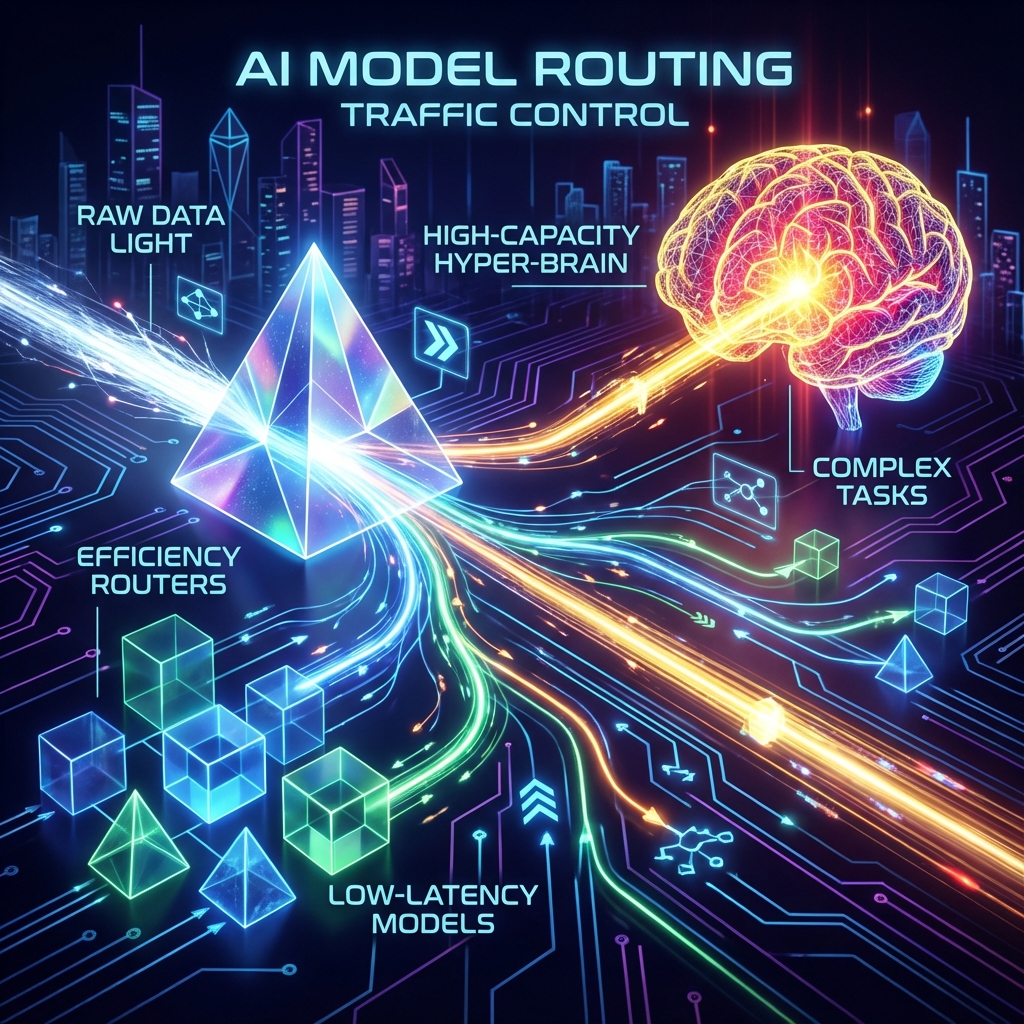
If you are building AI applications, you cannot treat all tokens as equal. You need a Cognitive Supply Chain.
The Router Pattern
Do not use GPT-4o for everything. Implement a router (Gateway) that inspects the prompt difficulty.
# The "Cognitive Router" Design Pattern

async def intelligent_route(user_query: str):
    # 1. Zero-Cost Route: Regex / Keywords
    if is_simple_command(user_query):
        return hardcoded_response(user_query)

    # 2. Low-Cost Classification (Llama-3-8b via Groq)
    # Cost: $0.05 / 1M tokens. Latency: 100ms.
    complexity_score = await classifier_model.score(user_query)

    # 3. Dynamic Routing
    if complexity_score < 0.3:
        # "Summarize this email"
        return await call_llm("gpt-4o-mini", user_query) # Cheap ($0.15)
    elif complexity_score < 0.8:
        # "Write a Python script to parse CSV"
        return await call_llm("gpt-4o", user_query)      # Standard ($5.00)
    else:
        # "Develop a novel mathematical proof"
        return await call_llm("o1-preview", user_query)  # Expensive ($15.00+)
4. Latency is the New Gold
Cheap models are usually fast. Expensive models are smart but slow (token generation speed is inversely proportional to parameter count).
Groq has demonstrated that running Llama 3 on LPUs (Language Processing Units) can achieve 800 tokens/second. This unlocks use cases like Real-time Voice conversation that feels human.
If your competitor is waiting 5 seconds for GPT-4 to "think," and you are responding in 200ms with Llama-3, you win. Speed generates trust.
5. The "Embedded Intelligence" Future
When a resource becomes near-free ($0.15/1M tokens), it stops being a "Feature" and starts being a "Property" of the material.
- Smart Objects: Your database won't just store data; it will explain data. (Postgres + pgvector + Local LLM).
- Self-Healing UI: When a user encounters an error, the frontend catches the stack trace, sends it to a mini-LLM, and shows the user a "Fix It" button instead of a crash report.
The cost of cognition is racing to zero. The value of orchestrating that cognition is racing to infinity.
Is Your AI Stack Leaking Money?
We implement "Cognitive Routers" that slash your AI bills by 80% while improving latency. Stop paying for Ph.D.s to do intern work.
Audit My AI Spend